
Net Metering and Gross Metering

In the context of grid-connected solar power systems, Net Metering and Gross Metering are two fundamental mechanisms that govern how the electricity generated by your solar panels interacts with the utility grid and how you are compensated for it. The choice or availability of one over the other significantly impacts the financial viability and operational strategy of a solar installation.
Let's delve into a detailed comparison:
1. Net Metering

Concept: Net metering is a billing mechanism that allows consumers who generate their own electricity (typically with solar panels) to feed excess electricity back into the utility grid. When the solar system produces more power than the consumer needs at that moment, the surplus electricity flows to the grid. The consumer's electricity meter, often a bi-directional (or net) meter, records both the electricity imported from the grid and the electricity exported to it.
How it Works:
Self-Consumption First: The electricity generated by your solar panels is first used to meet your own immediate consumption needs within your premises.
Export Surplus: If your solar panels produce more electricity than you are consuming, the excess is automatically exported to the grid.
Import Deficit: If your consumption exceeds your solar generation (e.g., at night, on cloudy days, or during peak demand), you draw electricity from the grid as usual.
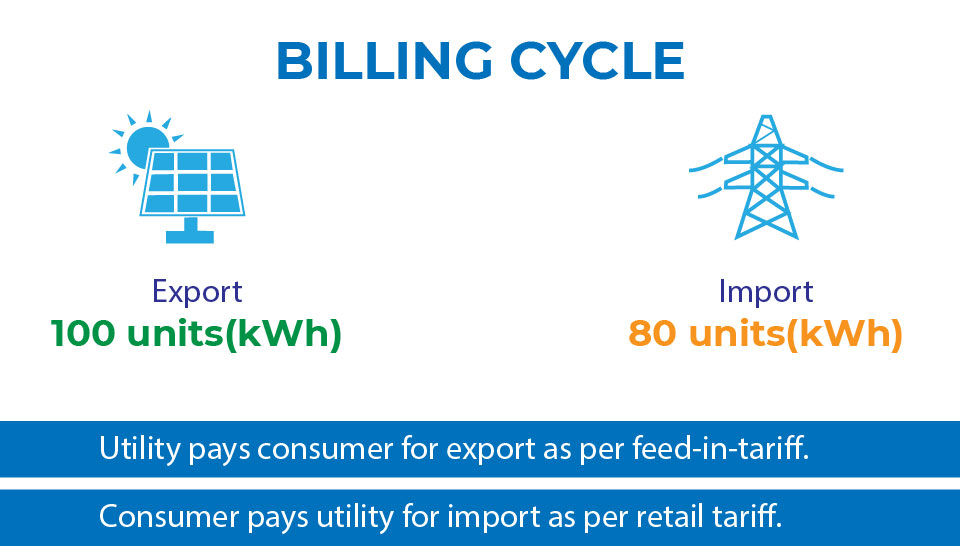
Net Billing: At the end of the billing cycle (usually monthly), the utility calculates the "net" difference between the electricity you imported from the grid and the electricity you exported to it.

If you import more than you export, you pay the utility for the net units consumed, typically at the prevailing retail tariff rate.
If you export more than you import, you receive a credit on your bill for the net surplus. This credit is compensated at the Feed-In Tariff and the amount is offset with the Fixed Charges (Sanctioned Load Charges).
Meter Type: A single bi-directional meter is used, which measures electricity flow in both directions (import and export).
2. Gross Metering

Concept: Gross metering is a mechanism where all the electricity generated by your solar system is exported directly to the utility grid, irrespective of your consumption. You cannot directly consume the power your solar panels produce. Instead, you purchase all the electricity you need from the grid at the retail tariff, and you are separately paid for all the electricity your solar system feeds into the grid, usually at a pre-determined "feed-in tariff" (FiT) rate.
How it Works:
Full Export: The entire electricity output from your solar panels is immediately and fully exported to the grid. There's usually a separate meter to record this.
Full Import: You buy all the electricity you need for your home or business directly from the grid, and this is measured by your standard consumption meter.
Separate Billing: You receive two separate financial transactions:
A bill for the total electricity consumed from the grid.
A payment for the total electricity generated by your solar system and exported to the grid, based on the agreed FiT rate.
Meter Type: Typically, two meters are used: one to measure the total energy generated by your solar system and exported to the grid, and another standard meter to measure your consumption from the grid.
Detailed Comparative Analysis
Feature | Net Metering | Gross Metering |
|---|---|---|
Self-Consumption | Primary: Solar power is first used on-site; only surplus is exported. | None: All generated solar power is exported to the grid; no direct self-consumption. |
Metering | Single bi-directional meter records both import & export. | Two separate unidirectional meters (one for generation/export, one for import/consumption). |
Billing Mechanism | "Net" difference between imported and exported units is billed/credited. | Two separate transactions: Pay for all consumption, get paid for all generation. |
Financial Benefit | Primarily reduces your electricity bill by offsetting consumption. Can lead to a zero bill or credits. | Primarily generates an income from selling all generated electricity. |
System Sizing | Often sized to offset a significant portion of the consumer's own electricity demand. | Can be sized to maximize generation, even if it far exceeds immediate consumption, as all power is sold. |
It's crucial for any potential solar investor to understand the specific policies applicable in their region and for their system size.
Understanding the key differences between the two metering setups, the retail and the FiT tariffs can help you make informed decisions to maximize the savings potential of a Solar On-Grid installation.
Value Your Solar Generation: See how much each unit of solar power you produce is truly worth, whether it's directly offsetting a high retail bill or earning a separate, often lower, FiT.
Optimize System Sizing: Make informed decisions about how large your solar system should be to align with your consumption patterns and the most favorable compensation mechanism available in your region (like Bengaluru, where KERC policies apply).
Forecast Savings Accurately: Predict the real financial returns and payback period of your solar investment by understanding the financial impact of both consuming your own power and exporting any surplus.
Don't wait to embrace solar savings! Contact us right away so we can understand your unique energy needs and design a customized solar solution perfect for your home or business. Let's power a cleaner, greener and better future together!